Investment Planning: How Big is Your Nest Egg Really

Investment Planning: How Big Is Your Nest Egg Really?

Author: Chris Steward, CFP®, CFA®, RICP®, M.A. (CANTAB) | Director of Investments at Impact Advisors Group

If your 401(k) statement says $2 million, how much of that money is actually yours to spend? As you reach your mid 50s, retirement seems less of a far-off goal or academic exercise and begins to take on real implications. You may consider yourself a good saver, and have watched your 401K grow over the years as you dutifully made contributions year after year. Remember the old saying about counting your chickens before they are hatched. Although your nest egg may look big, it may be filled primarily with pre-tax dollars that could reduce your standard of living in retirement.
 
When you contribute to a traditional 401(k) or IRA, you effectively take on a silent partner: the IRS. While you receive a tax deduction today, the government retains a claim on a portion of those assets through future income taxes, and at some point is sure to come calling for its share, whether from you or from your heirs. One former colleague called 401(k)’s and IRA’s tax disadvantaged accounts as they are virtually the only assets that do not get a tax step up in your estate when your assets are eventually passed along.
 
The stock market has done exceedingly well versus history doubling in the last 3 1/2 years and tripling in just over 7 years. These strong returns have caused many retirement accounts to grow far beyond what investors expected. While that growth is welcome, it can also create larger future tax liabilities as withdrawals and required minimum distributions (RMDs) increase. Although it is gratifying to see my investment accounts grow, I recognize that the net dollars that I can spend will be much smaller than the headline number of my account value.
 
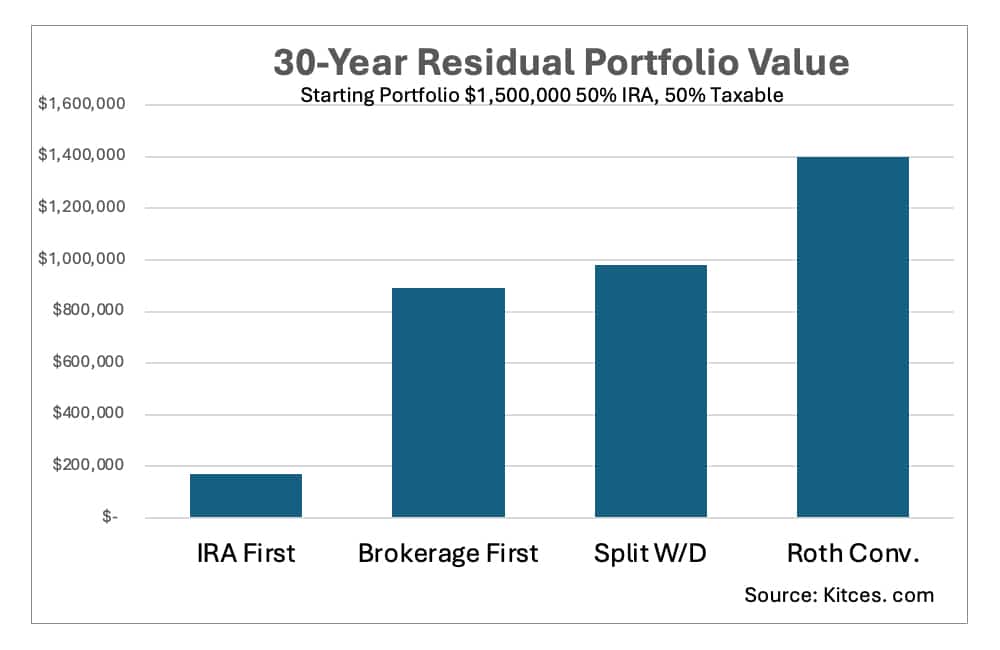
It is not just how much you have in different accounts, but also how you tap those accounts in retirement that matters. An analysis by Michael Kitces showed that being thoughtful about where to take money from can have a huge impact on your residual portfolio value. His analysis showed that, for a retiree with $1.5 million split between an IRA and a Taxable account, the residual value of the portfolio after 30 years of 5.3% inflation-adjusted withdrawals can range from $170,000 to $1.4 million.

Investment Planning: How Big Is Your Nest Egg Really

Much of the difference in these outcomes arises from the fact that IRA and 401k withdrawals are treated as taxable income, which often push retirees into a higher tax bracket, and can also trigger IRMAA surcharges.
 
It is easy to see why the rule of thumb in retirement is to spend down your taxable assets before spending you IRA or 401(k). However, that simple rule still leaves significant money on the table. Using a “fill the bracket” Roth conversion strategy, at least in this analysis, resulted in 50% more in residual portfolio assets over the simple rule of thumb. A Roth conversion strategy involves voluntarily paying today’s tax rates on assets moved from a traditional IRA into a Roth IRA, generally during lower-income years. While this creates a current tax bill, it can reduce lifetime taxes paid and provide greater flexibility later in retirement.
 
The conventional wisdom is that getting the best portfolio return is the single biggest factor in enjoying retirement. But building wealth is only half the challenge. The other half is keeping as much of it as possible. For many retirees, thoughtful tax planning can add as much value as investment performance, generating a higher standard of living by optimizing withdrawals from your investment accounts.

Impact Advisors Group LLC (“[IAG]”) is a registered investment advisor offering advisory services in the State of Massachusetts and in other jurisdictions where exempted. Registration does not imply a certain level of skill or training. The information on this site is not intended as tax, accounting or legal advice, as an offer or solicitation of an offer to buy or sell, or as an endorsement of any company, security, fund, or other securities or non-securities offering. This information should not be relied upon as the sole factor in an investment making decision. Past performance is no indication of future results. Investment in securities involves significant risk and has the potential for partial or complete loss of funds invested. It should not be assumed that any recommendations made will be profitable or equal any performance noted on this site. The information on this site is provided “AS IS” and without warranties of any kind either express or implied. To the fullest extent permissible pursuant to applicable laws, Impact Advisors Group disclaims all warranties, express or implied, including, but not limited to, implied warranties of merchantability, non-infringement, and suitability for a particular purpose. IAG does not warrant that the information on this site will be free from error. Your use of the information is at your sole risk. Under no circumstances shall IAG be liable for any direct, indirect, special or consequential damages that result from the use of, or the inability to use, the information provided on this site, even if IAG or a IAG authorized representative has been advised of the possibility of such damages. Information contained on this site should not be considered a solicitation to buy, an offer to sell, or a recommendation of any security in any jurisdiction where such offer, solicitation, or recommendation would be unlawful or unauthorized.