Investment Planning: The Hidden Costs of Doing It Yourself

Investment Planning: Private Equity and Hedge Funds Stumble

Author: Chris Steward, CFP®, CFA®, RICP®, M.A. (CANTAB) | Director of Investments at Impact Advisors Group

Back in my high school years in the mid-1970s, investing your own money was difficult and expensive. The fund company Vanguard was founded in 1975, which was also the year the SEC abolished fixed commission rates on the New York Stock Exchange, ending 183 years of price-fixing. Competition among brokers, and the rise of discount brokers like Charles Schwab, pushed commissions from over 80 cents per share to roughly four cents by 2000.
 
Today there are thousands of mutual funds and ETFs to choose from to build your own portfolio, and management fees are lower than they were even a decade ago. Although it has become easier than ever to manage your own money, the question is: should you? The answer is: probably not.
 
Marketing research firm DALBAR conducts an annual Quantitative Analysis of Investor Behavior (QAIB) estimating how the Average Equity (and Bond) Investor performed. The latest report revealed that the Average Equity Investor earned just 16.54% in 2024, compared to the S&P 500’s 25.02% return; that’s an 848 basis-point gap.
 
But that is just one year; what about the longer term? Over the past decade, DALBAR estimates the average equity fund investor earned roughly 9.8% annually, compared with an annualized return of about 13% for the S&P 500. The average asset-allocation fund investor earned closer to 4%, versus approximately 8% for a balanced 60/40 portfolio. If we look at an even longer period like 30 years, DALBAR estimated that there is a 3.5% gap.
 
What is causing this performance gap? Chalk it up to investor behavior. Despite strong performance in the equity markets, investors continue to underperform by selling after a downturn and buying after a rally.
 
As Forbes points out: “While market history reveals generally strong long-term returns, the path to those returns has been anything but smooth. Since 1928, the S&P 500 has delivered an annualized total return of roughly 10–12% when dividends are reinvested. Over that same history, the average intra-year decline has been about 16%, even in years that finished positive.”
 
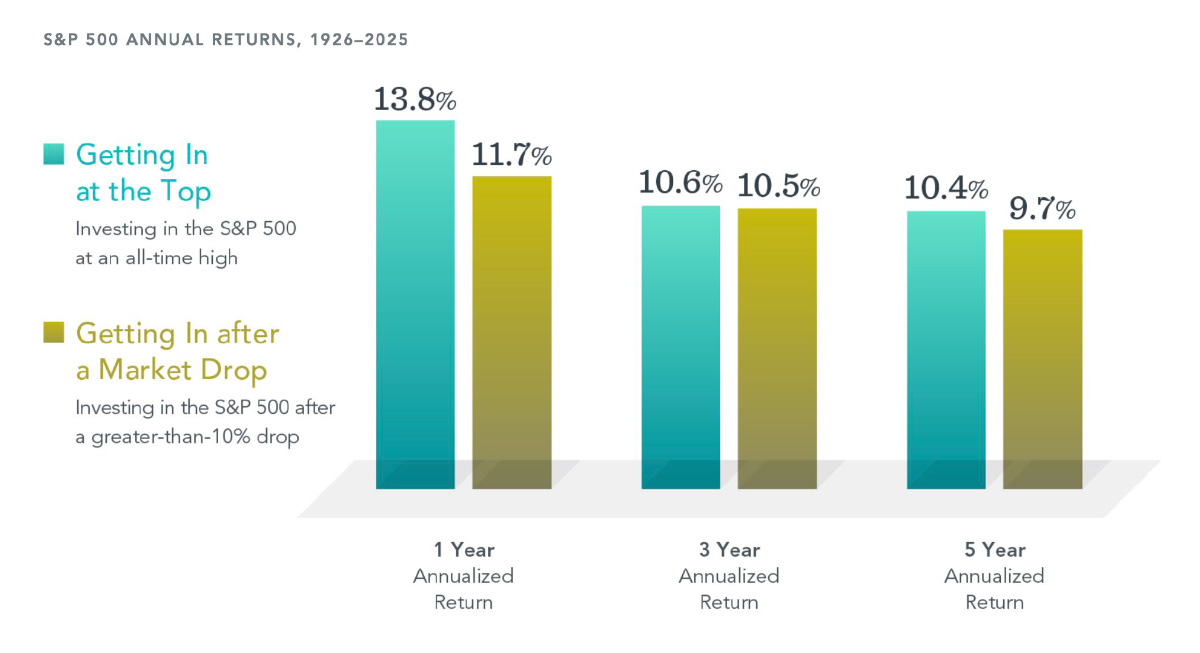
That means that for skittish investors, there is generally always a time to pull out of the market. But what if we were incredibly perceptive and always invested after a market correction?
 
Fund manager DFA Puts it: “Frequent reports of all-time market highs may keep you from buying, thinking surely what goes up must come down, so I better wait. But research shows that buying shares at all-time records has, on average, produced similar returns to stocks bought following a sharp decline. That means trying to time when to get into and out of markets is unlikely to lead to better results.”

Let’s try to put an estimate just how much the cost is to a DIY investor vs. using a financial professional. We assume a 58-year-old with $600,000 to invest. First, due to the Behavioral Gap that DALBAR identified of 3.5%, over 10 years that would amount to $210,000. If we include Tax Drag of 0.6% that comes to $36,000. So far, the DIY investor would have been better off by $246,000 through hiring a financial advisor. But there is also some cost in time spent by the DIY investor also. If that person spent 5 hours a week managing their assets, that amounts to a Time Cost of $104,000 over 10 years assuming $50 per hour of either work or leisure time lost. One last item to consider is the “Planning Gap.” Those items like insurance, and estate planning whose costs often aren’t apparent until it is too late to fix them. It is impossible to put a number on this factor, but it should be clear that the advice of a good financial advisor can be immense.

Impact Advisors Group LLC (“[IAG]”) is a registered investment advisor offering advisory services in the State of Massachusetts and in other jurisdictions where exempted. Registration does not imply a certain level of skill or training. The information on this site is not intended as tax, accounting or legal advice, as an offer or solicitation of an offer to buy or sell, or as an endorsement of any company, security, fund, or other securities or non-securities offering. This information should not be relied upon as the sole factor in an investment making decision. Past performance is no indication of future results. Investment in securities involves significant risk and has the potential for partial or complete loss of funds invested. It should not be assumed that any recommendations made will be profitable or equal any performance noted on this site. The information on this site is provided “AS IS” and without warranties of any kind either express or implied. To the fullest extent permissible pursuant to applicable laws, Impact Advisors Group disclaims all warranties, express or implied, including, but not limited to, implied warranties of merchantability, non-infringement, and suitability for a particular purpose. IAG does not warrant that the information on this site will be free from error. Your use of the information is at your sole risk. Under no circumstances shall IAG be liable for any direct, indirect, special or consequential damages that result from the use of, or the inability to use, the information provided on this site, even if IAG or a IAG authorized representative has been advised of the possibility of such damages. Information contained on this site should not be considered a solicitation to buy, an offer to sell, or a recommendation of any security in any jurisdiction where such offer, solicitation, or recommendation would be unlawful or unauthorized.