The Hidden Risk Most Business Owners Carry: “The Bottleneck”
The Bottleneck is the hidden liquidity risk many business owners carry. Learn how to build flexibility beyond your business.

Author: Chris Steward, CFP®, CFA®, RICP®, M.A. (CANTAB) | Director of Investments at Impact Advisors Group
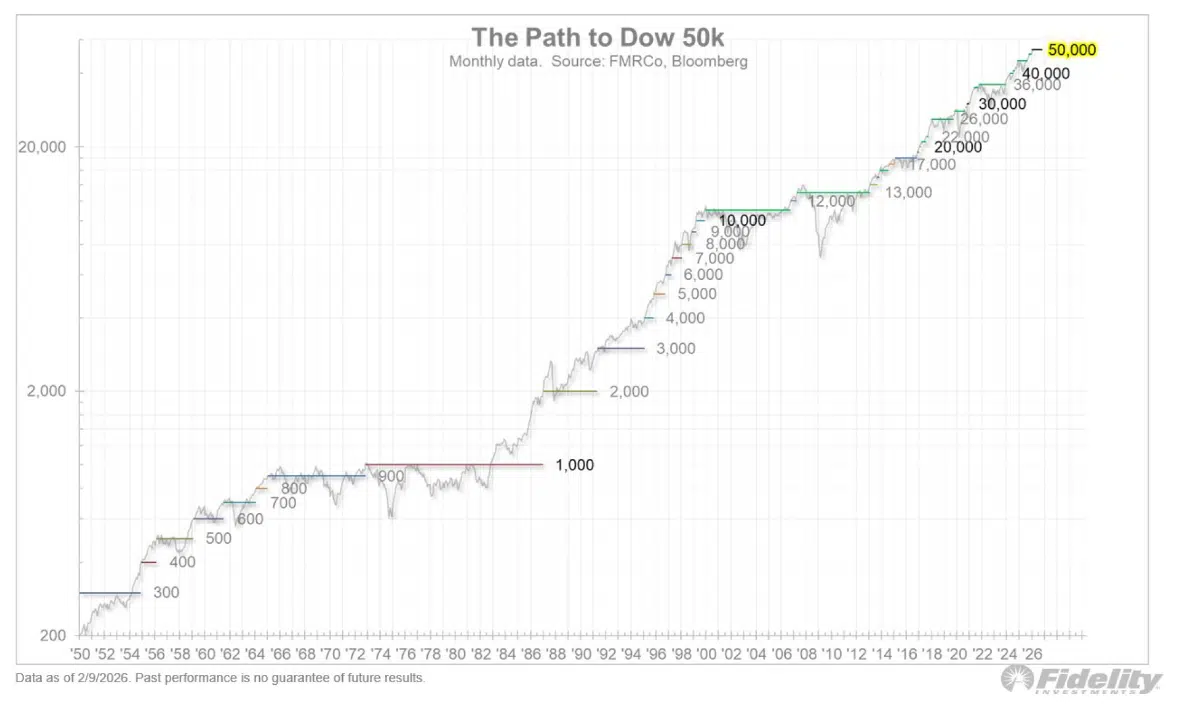
As I have mentioned before, one of my favorite strategists is Jurrien Timmer of Fidelity. Jurrien has a wonderful way of providing clear explanations using long term data, including the Dow Jones reaching a record 50,000. Of course, there are always lots of different themes at play in the market at any time such as the theme of AI winners and losers, and a large drop in the precious metals and crypto. But aside from all of this white noise, beneath these headlines the broad market continued to broaden in the best way possible as the Equal-Weighted S&P 500 closed a bit of the gap with the Market-Weighted S&P 500 and Dow Jones Industrials Index reached the 50,000.
Yes, I am old enough to remember the headlines of prior Dow Jones records. Not so much the “Dow Jones at 1,000” but certainly the 3,000 and 10,000 milestones. Of course, there is no special significance to 50,000 except that it is just a very large round number. But like birthdays and anniversaries ending in a zero, they can make us pause and remember how we got here.
The dominance of the “Magnificent 7” stocks in recent years have created a top-heavy market. Readers of my past posts will remember my concerns over market valuations being expensive relative to history. In most cases extreme valuations will eventually result in a sharp correction which could likely drag down the whole market. However, now with the Magnificent 7 stocks essentially going sideways since October while the rest of the market continues to rise, this goes a long way toward correcting the top-heaviness of the market. The Magnificent 7 are so far ahead that it will take a lot to catch up, but it appears to finally be happening. A similar broadening is also happening in markets around the world.
The earnings momentum which began in late 2023 has continued. The 2026 and 2027 estimates have continued to rise at a 14-15% clip, which is also roughly equal to the trailing 5-year Annualized Growth Rate. But dig a little deeper and it becomes clear that like price performance, Tech stocks have dominated the earnings picture as well.
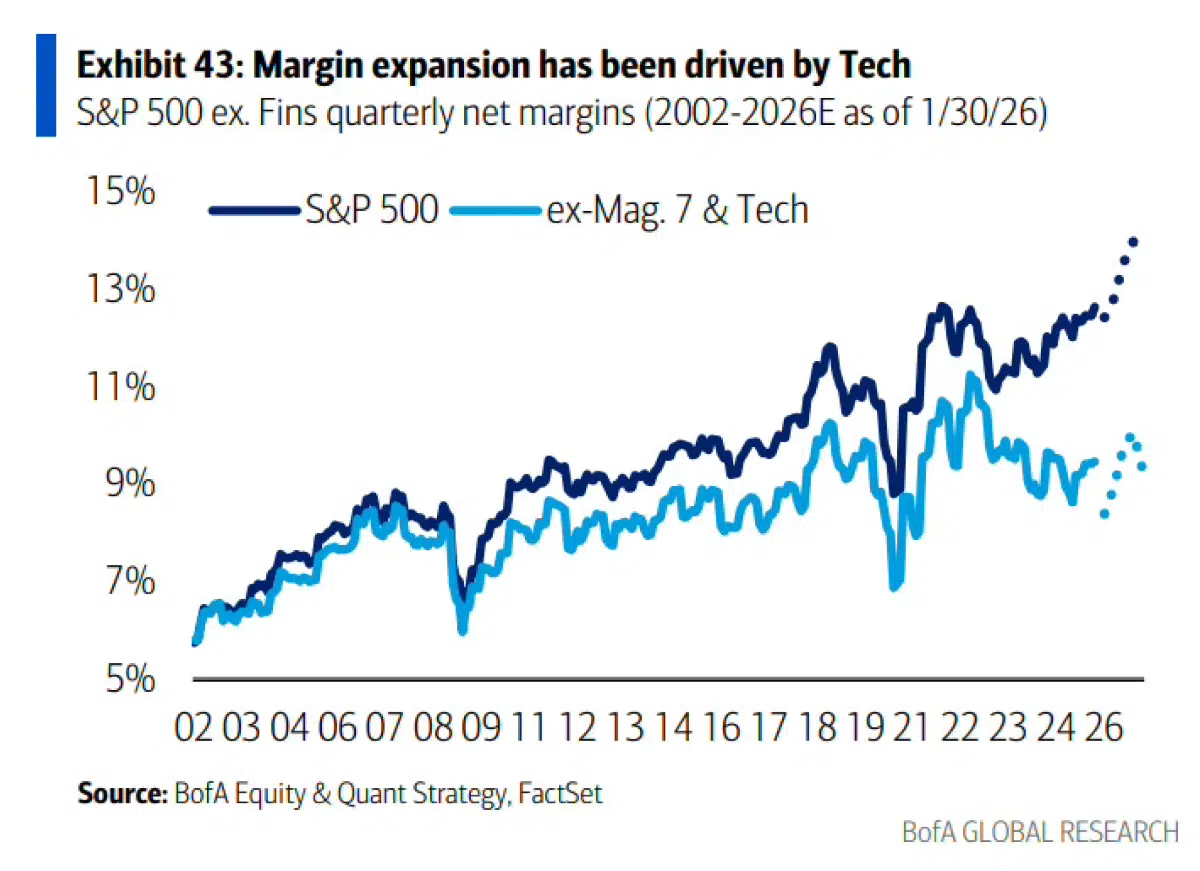
Since the early 2000s, net margins for the S&P 500 have trended steadily higher, but margins outside tech have risen far more modestly and remain significantly lower. The many tech companies have highly scalable firms with strong pricing power low marginal costs, and global reach. These characteristics all make margin expansion easier. Margins in traditional sectors remain constrained by labor costs, capital intensity and stiff competition.
Earnings are the lifeblood of the stock market. The impressive earnings growth of the past few years emboldened investors to pay less attention to valuations. While the Shiller 10-year Cyclically Adjusted P/E Ratio, or CAPE ratio, remains elevated vs. history at 40x, but a bit less so when looking at P/Es using earnings forecasts for the next 12 months. Then questions remains: are we in a boom or a bubble? Only time will tell, and the best course, as always, is to remain in the market. That said, there are ways to mitigate down markets without sacrificing all of the potential upside if the stock market boom continues. Let us know if you want to explore any of these strategies in more detail.

The Bottleneck is the hidden liquidity risk many business owners carry. Learn how to build flexibility beyond your business.

Explore smarter retirement planning beyond target date funds with a customized glide path built for your goals and risk tolerance.

Thoughtful planning creates confidence. Prepare your finances, career, and family goals for a stronger, more focused 2026.

Before you invest, protect your plan. Discover how Matt Williams uses protection-first planning to build stronger, more resilient financial strategies.