AI: A BOLD Prediction for the Future?

Investment Planning: A BOLD Prediction for the Future?

Author: Chris Steward, CFP®, CFA®, RICP®, M.A. (CANTAB) | Director of Investments at Impact Advisors Group

Investors are pouring trillions of dollars into artificial intelligence. But history suggests that the companies leading a technological revolution are not always the ones that generate the best long-term investment returns.  

We have discussed the concentration of the US stock market several times in the past. One stock, Nvidia, is now larger relative to the rest of the stock market than any company over the past 50 years, beaten only by General Motors in the 1970s. The market has driven up not only Nvidia, but also the stocks of memory-chip makers which are also crucial to AI. Estimates of memory-chip market capitalization of companies like Samsung, Micron, SK Hynix, Sandisk, and Kioxia have risen 10-fold in just 18 months, reaching about $4.5 trillion in June 2026, up from $446 billion in January 2025. 

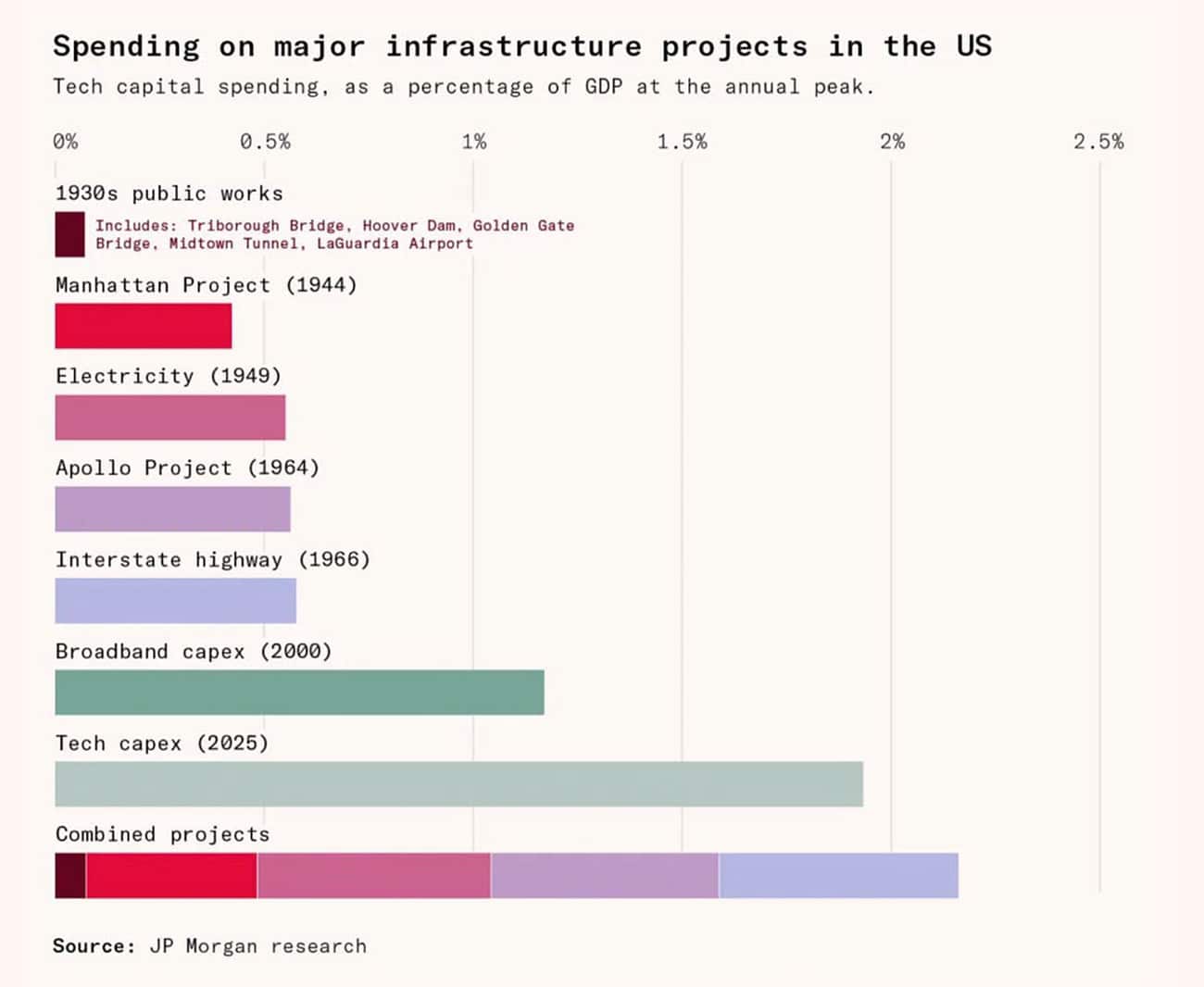
Not only is the stock market concentrated in Technology Stocks, spending on AI-related infrastructure has skyrocketed. This analysis by JP Morgan shows the level of spending on various Public Works projects as a percentage of GDP. Tech sector spending is close to 2% of GDP, and only slightly lower than all of the other major infrastructure projects combined. 

This spending spree also shows up in Capex for some of the largest technology companies. As strategist James Eagle points out: “The biggest technology companies are spending as if AI will become a large everyday business. That is the part to watch: the money is being committed before the eventual revenue is fully visible. Annual capex across Alphabet, Amazon, Meta, Microsoft and Oracle rose from about $162 billion in 2022 to about $448 billion in 2025. By the final quarter of 2025, the five companies were spending roughly $141 billion in one quarter. The buildout is real and these aren’t projections. The return is still the open question, however.” 

Investors often assume today’s market leaders will dominate forever. History says otherwise. Many of us remember the Palm Pilot, Sony Walkman, BlackBerry, AOL, Wang word processors, and countless other companies that once seemed untouchable. Today’s economy is vastly different from the “diminishing economies of scale” that I learned in my college economics course as technology products and services can often be produced at virtually no cost.   

Here is how Peter H. Diamandis, author of the book “Bold: How to Go Big, Create Wealth and Impact the World” with Steven Kotler, describes his “Six D” model. 

Overview of the 6 D’s:

1. Digitalization: A product or service is digitized into ones and zeros … and can be replicated and transmitted for a near-zero marginal cost. 

2. Deceptive Growth: During the early days of exponential growth, the doubling of small numbers seems deceptively flat. If a Cherry Grove takes 30 days to fully blossom and the number of flowers double every day, on day 23 only 1% of the buds have opened. Only on day 27 are more than 10% of the flowers visible.  

3. Disruptive Growth: If something doubles 30 times, it has grown 1 billion-fold.  

4. Dematerialization: Think about all the 1980s or ’90s technology that now comes free on your cell phone: GPS, video conferencing, photography, video recording, radio, books, records, maps, and. This technology on today’s smartphones would have cost over a million dollars if purchased separately in the 1980s. 

5. Demonetization: Once the cost of replication and transmission of a product/service is near zero, it ultimately leads to demonetization, like digital photography has slashed prices, and decimated demand for other cameras. 

6. Democratization: Lastly, products and services become Democratized, and available to billions of users across the planet. 

For investors, the key question isn’t whether AI will change the world—it almost certainly will. The more difficult question is who will ultimately capture the economic valueTechnological revolutions create enormous wealth, but rarely in the way investors initially expect. Railroads, automobiles, the internet, and smartphones all transformed society. Yet many of the early market leaders eventually disappointed investors. AI may follow a similar path. Rather than chasing today’s most popular names, long-term investors should focus on owning diversified portfolios that can benefit regardless of which companies ultimately emerge as the winners. Remember that the bulk of the money during the Yukon Gold Rush went to the providers of picks and shovels, not the prospectors. 

Impact Advisors Group LLC (“[IAG]”) is a registered investment advisor offering advisory services in the State of Massachusetts and in other jurisdictions where exempted. Registration does not imply a certain level of skill or training. The information on this site is not intended as tax, accounting or legal advice, as an offer or solicitation of an offer to buy or sell, or as an endorsement of any company, security, fund, or other securities or non-securities offering. This information should not be relied upon as the sole factor in an investment making decision. Past performance is no indication of future results. Investment in securities involves significant risk and has the potential for partial or complete loss of funds invested. It should not be assumed that any recommendations made will be profitable or equal any performance noted on this site. The information on this site is provided “AS IS” and without warranties of any kind either express or implied. To the fullest extent permissible pursuant to applicable laws, Impact Advisors Group disclaims all warranties, express or implied, including, but not limited to, implied warranties of merchantability, non-infringement, and suitability for a particular purpose. IAG does not warrant that the information on this site will be free from error. Your use of the information is at your sole risk. Under no circumstances shall IAG be liable for any direct, indirect, special or consequential damages that result from the use of, or the inability to use, the information provided on this site, even if IAG or a IAG authorized representative has been advised of the possibility of such damages. Information contained on this site should not be considered a solicitation to buy, an offer to sell, or a recommendation of any security in any jurisdiction where such offer, solicitation, or recommendation would be unlawful or unauthorized.